Building a World-Class Financial Management System Requires More Than Reporting — It Requires a Nervous System
2026-07-07
Building a World-Class Financial Management System Requires More Than Reporting — It Requires a Nervous System
In February 2022, the State-owned Assets Supervision and Administration Commission of the State Council (SASAC) issued a document — the “Guidelines on Accelerating the Construction of a World-Class Financial Management System for Central Enterprises.” The guidelines clearly stated the need to “accelerate the development of a world-class financial management system,” driving central enterprises’ financial management to transition from informatization to digitalization and intelligence, achieving “real-time penetration and intelligent supervision.”
This sounds ambitious, but behind it lies a very specific problem: Why does the financial management of central enterprises need “penetration”?
Because you cannot see what is really happening.
A report can tell you how much money a company made, but it cannot tell you why it made that money, which parts are leaking value, or where risks are forming. Central enterprises are massive — hundreds of subsidiaries under one group, each with dozens of accounts. When all that data is aggregated layer by layer, what emerges is an “average” or a “weighted number.” And risk is precisely what gets hidden in those averages.
Traditional Financial Management Is a System Without Sensory Capability
Traditional financial management is, in essence, management of results. It can see the total, but not the structure. It can tell you what the profit is, but it cannot answer: “Where did the profit come from? Which business line is contributing? Which link is broken?”
This is like a person who only checks their weight and height during a physical exam, and assumes they are healthy. If the heart muscle is dying, weight won’t tell you. If arteries are clogging, height won’t warn you. Financial penetration is the CT scan — not looking at totals, but at structure; not looking at appearances, but at the underlying reality; not looking at a single point in time, but at the trend across ten quarters.
Financial Penetration Turns What Is “Invisible” into What Is “Visible”
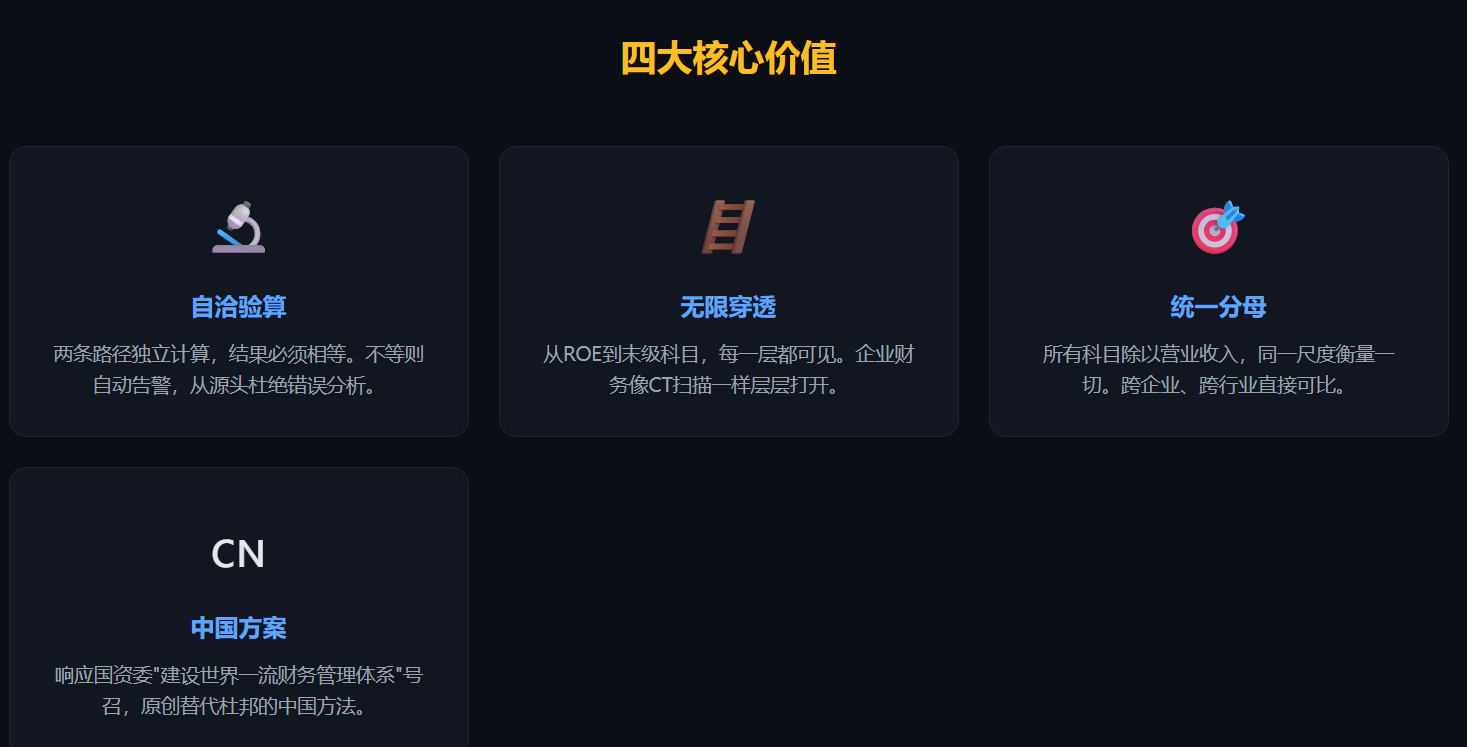
After 31 years in financial research, I developed a system called “Wu’s ROE” Financial Penetration System. It has three core actions: unified denominator, infinite layer-by-layer penetration, and self-validating verification.
Unified denominator means dividing all asset, liability, and profit accounts by operating revenue, so every metric is measured on the same scale. Infinite penetration starts from ROE and breaks it down layer by layer — penetrating net margin, turnover ratios, leverage ratios, all the way down to the most granular account level, until the root cause of a problem is found. Self-validating verification means calculating ROE through two independent paths — the results must be equal. If they are not, the system automatically issues a warning.
This system does not look at how much money a company made this year. It breaks down ROE layer by layer — 10 quarters of data plotted as a trend line. If the line is moving up, the company is genuinely improving. If it is moving down, there is a problem.
The Prerequisite for Penetration Is That the Roots Are Clean
Penetration is an action, but what it reveals depends on whether the underlying data is clean. If the data itself is distorted, untraceable, or manipulated, the signals that penetrate upward will also be distorted. This is why another system is needed — the JingGen (Root-Cleaning) System.
The JingGen System does not create prettier reports. It starts from the atomic task layer of the enterprise — procurement, payments, taxation, operations — making every business action transparent, traceable, and tamper-proof. When the roots are clean, signals can be transmitted. When signals are transmitted, regulators can see. When regulators can see, decisions can be made correctly.
Wu’s ROE + JingGen System = The Enterprise Nervous System
Wu’s ROE is the conducting nerve. The JingGen System cleans the endings. Together, they form a complete “enterprise nervous system.” It gives the enterprise the ability to sense, and gives regulators a visual, data-driven basis for decision-making.
I used this system to analyze Vanke. In 2022, I penetrated Vanke’s public financial reports and identified that the “construction-in-progress development properties” account was abnormally high, with a sharp concentration in the Shanghai region. At the time, the market was optimistic — no one thought Vanke was in trouble. But after I published my findings, Vanke’s stock price fell from RMB 33 to RMB 3. The results of the penetration were validated by the market.
What the Nation Needs to Build Is Not a Reporting System — It Is a Sensing System
What central enterprises need most is not a more beautiful set of reports, but an infrastructure that can truly sense their own health. What the nation needs to see is not “the total has grown,” but “is the underlying structure healthy, is the composition sound, is the trend moving upward?”
The “real-time penetration and intelligent supervision” proposed by SASAC is, in essence, about building a nervous system for central enterprises. And the prerequisite for a nervous system is: clean endings, clear transmission, and visibility at the top.
When the roots are clean and the nervous system is connected, the enterprise has armor.
— Wu Huan — 31 years of financial research
Personal Website: aurum.zeabur.app
System Entry: wushiroe.zeabur.app